High on Life 2 Review: The Psychedelic Sequel That Hits Harder Than the Original
High on Life 2 Review: Squanch Games Delivers a Dope Trip
The original High on Life carved out a niche for itself—a chaotic, foul-mouthed, and thoroughly self-aware first-person shooter dripping in the specific brand of absurd, fourth-wall-breaking humor popularized by Rick and Morty creator, Justin Roiland. While the original was polarizing, its sequel, High on Life 2, attempts to refine the formula, delivering a more polished, tighter, and arguably more addictive experience.
Despite the highly publicized departure of Roiland from Squanch Games prior to launch, the studio has clearly regrouped, taking community feedback to heart. This new intergalactic trip, available on PS5, Xbox Series X|S, and PC (and day one on Xbox Game Pass), is less of a repetitive novelty and more of a genuinely creative shooter that manages to course-correct some, though not all, of its predecessor’s flaws. Playing High on Life 2 is indeed a ‘high’—a vibrant, irreverent FPS that surprisingly elevates its core mechanics.
This review dives deep into how the narrative flipped, the gunplay evolved, and whether the non-stop verbal assault from your talking weapons still manages to land. Spoiler alert: prepare for moments of extreme creativity, sheer madness, and guaranteed laughter.
The Narrative Flip: From Hero to Fugitive
If you thought the opening of the first game was strange, High on Life 2 ratchets up the psychedelics immediately. The sequel picks up right after the events of the original game, but instead of enjoying our status as a celebrated bounty hunter, we are instantly transformed into public enemy number one. Allying with your rebellious sibling, the goal shifts to taking down the nefarious Rhea Pharmaceutics—a corporation aiming to convert humanity into a key ingredient for a galactic ‘drug.’
The script maintains the signature blend of dark, absurdist humor, gratuitous violence, and cutting social critique. However, the dynamics are altered. We are now the hunted, the alienized minority in the galaxy, which adds a new layer to the already prevalent themes of intergalactic racism and corporate exploitation, often seen in titles like Helldivers 2 or Warhammer 40K. Chasing down six high-ranking executives and allies of Rhea Pharmaceutics forms the main structural backbone of the adventure.

While the overall narrative skeleton—travel to base, receive quest, execute, repeat—remains conventional, Squanch Games has listened to the overwhelming demand for greater mission variety. The result is a far less predictable series of quests that prevent the core structure from feeling stale.
Refining the Experience: Core Gameplay Improvements
The most significant achievements of High on Life 2 are found in its mechanical evolution and the improved pacing of its comedic timing. The studio consciously worked to make the minute-to-minute gameplay feel more dynamic and less repetitive. Here is a comparison of key areas:
| Feature | Original High on Life (HoL 1) | High on Life 2 (HoL 2) | Impact/Improvement |
|---|---|---|---|
| Traversal/Movement | Standard FPS movement, Jetpack limited. | High-speed Skate/Grind Mechanic, enhanced double jump. | Adds flow, speed, and verticality; integrates seamlessly with combat. |
| Humor Pacing | Frequent, often prolonged gags; potential for saturation. | More precise gags, better timing, greater mission variety. | Less irritating during crucial moments; jokes land more effectively. |
| Gunplay Fluidity | Solid, but occasionally stiff; inconsistent enemy reactions. | Tighter controls, improved haptic feedback (on consoles), better reactivity. | A more satisfying core shooter experience, though still not Doom-level. |
| Level Design | Larger, but sometimes sparse open-world zones. | Tailored levels emphasizing Skate mechanics and vertical exploration. | More memorable and complex maps utilizing new movement options. |
The Non-Stop Banter and Localization Woes
One element that remains constant is the sheer, overwhelming verbiage of the talking Gatlian weapons. They never shut up. During heated firefights, while navigating platforming sections, and even during cutscenes, your guns—old favorites and new additions—are relentlessly delivering street-level English slang and rapid-fire insults.

While the writing shows greater precision this time, avoiding the constant comedic saturation of the first game, this non-stop chatter presents a serious hurdle for non-native English speakers. For Spanish-speaking players, specifically, the localization is unfortunately still an issue. The Spanish-Latin American text translation is often too neutral and sometimes features errors.
Critically, the absence of proper Spanish voice acting is deeply felt. It is practically impossible to read the acid-laced dialogue subtitles while simultaneously dealing with a dozen angry aliens shooting at you. A full Spanish dub would make the game infinitely more accessible and enjoyable, allowing players to absorb the comedy without sacrificing situational awareness during frenetic combat.
Gameplay Evolution: Skateboards and Synergy
The basic DNA of High on Life 2 remains a first-person shooter, but the sequel significantly elevates both its combat prowess and its platforming ambitions. While it may not rival titans like Doom Eternal or the polished synergy of Destiny 2 in terms of pure trigger reactivity, the overall shooter experience is undeniably notable.
We gain access to new and returning Gatlians, each boasting unique personalities, firing modes, and alternate abilities crucial for completing puzzles and traversing environments. Although the aesthetic differentiation between some weapons could be greater, they all feel satisfyingly distinct in combat.

The Introduction of the Skate Mechanic
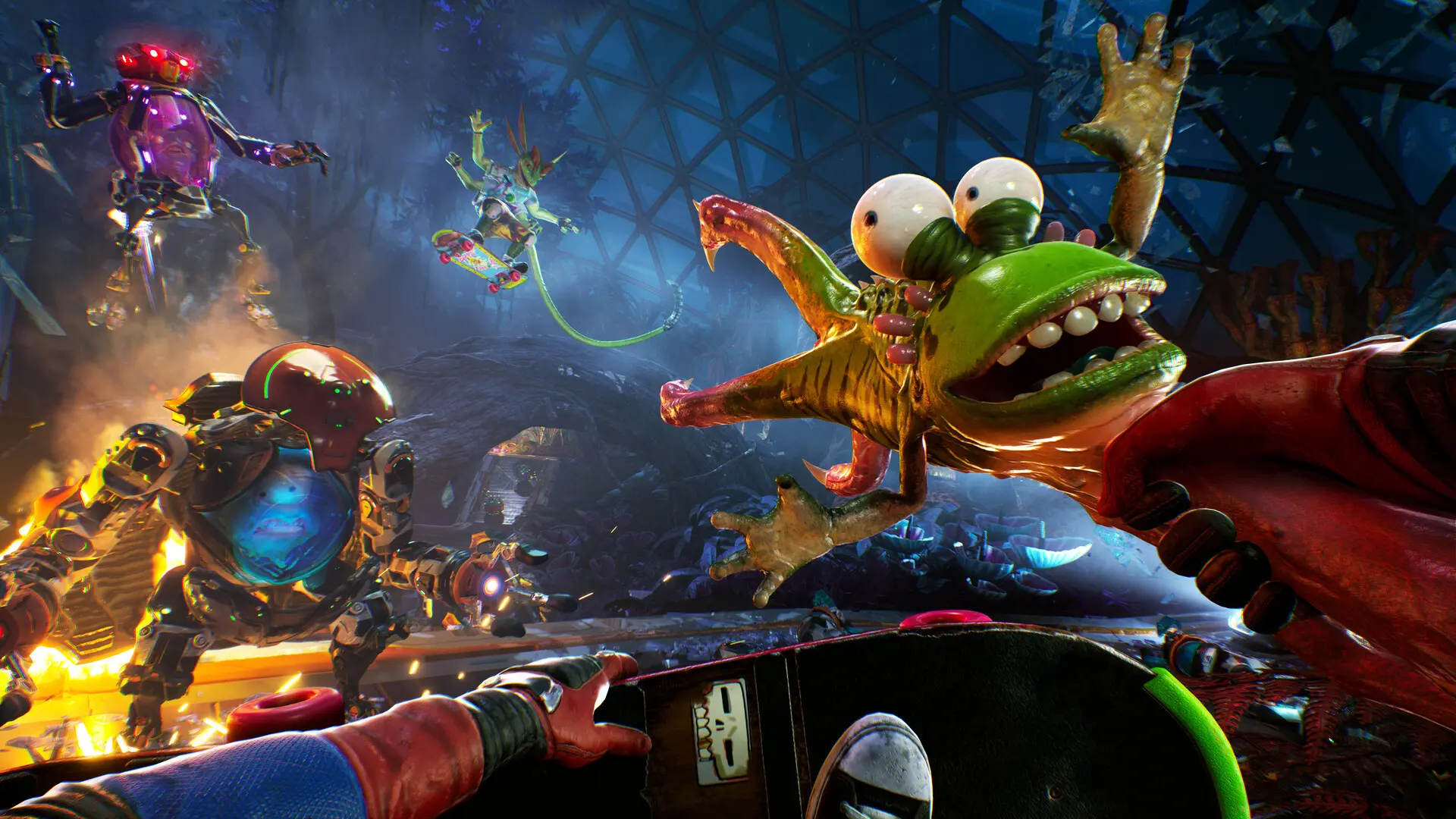
The single greatest mechanical addition is the integration of high-speed traversal. High on Life 2 bets heavily on movement, offering a new level of freedom and flow. When sprinting, our character deploys a makeshift skateboard, allowing us to rapidly cross the now expansive environments that have been explicitly designed with this movement in mind.
This mechanic includes:
- Grinding along cables and railings.
- Executing ‘Ollie 180s’ as a form of powerful double jump.
- Performing drop-ins on specific ramps and slopes.
This mix of rapid traversal and gunplay generates a kinetic synergy that far exceeds expectations. Skateboard grinding into a mid-air double jump before blasting an enemy with a precision shot is exhilarating. The combat is no longer stationary; you are constantly moving, boosting, and sliding while your weapons spew both bullets and insults at nearly the same velocity.
The Madness of Variety: Unexpected Side Quests
If the gameplay improvements are about precision, the mission design is about pure, unadulterated chaos. While the structure is repetitive, the content itself ensures maximum deviation from the norm. What begins as a simple bounty hunt can devolve into the most bizarre scenarios imaginable. This variety is perhaps what prevents the game’s core loop from becoming tiresome.

Just in the opening hours, players might:
- Visit an alien zoo where humans are the exhibit you can pet.
- Befriend a skater reptilian while establishing a base inside a cosmic playground.
- Infiltrate a planet-wide fan convention packed with sci-fi zealots.
- Attend a drug-fueled party with a newly acquired, rich talking weapon (complete with implied substance use mini-games).
- Engage in a live-action game of Clue/Cluedo that dictates your combat environment.
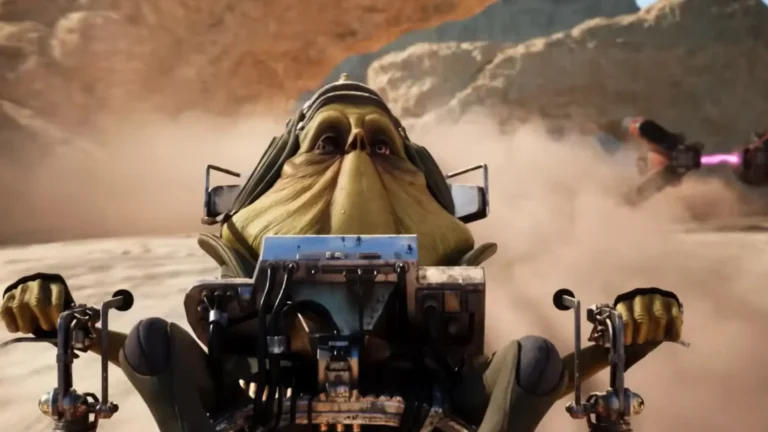
The game consistently throws curveballs, shifting genres and perspectives at random moments. One moment you are engaging in classic FPS combat; the next, you are forced into a boss fight conducted entirely within the pause menu (a brilliant ‘Kojima-esque’ moment) or emulating Japanese Famicom side-scrollers like Gourmet Warriors.
One of the highlights, cited by many critics, involves gaining access to a clandestine fight club by navigating through an enormous alien’s posterior—a sequence directly inspired by the famous arena challenge in The Elder Scrolls IV: Oblivion. These are not merely fetch quests; they are highly curated, unique scenarios that continually surprise the player.
Technical Performance and Stability Concerns
While High on Life 2 elevates its gameplay and writing, its technical execution on current-generation consoles (specifically the PS5 and Xbox Series X) leaves much to be desired at launch. The game utilizes Unreal Engine 5, which, while capable of producing stunning visuals, seems poorly optimized in its current state.

Frame rate stability is a major issue; the game rarely maintains a solid 60 frames per second, frequently dipping below this mark during busy combat or high-speed traversal. Furthermore, texture loading deficiencies and graphical pop-in are noticeable, breaking immersion. The technical polish feels lacking, suggesting the game was rushed or requires significant post-launch patching to smooth out the experience.
Length, Difficulty, and Availability
The main storyline of High on Life 2 runs approximately 12 hours, comparable to the first installment. However, thanks to the quality and depth of the secondary content—which includes various minigames, challenges, and base upgrades—the overall playtime can easily stretch beyond 20 hours for completionists.
Regarding difficulty, the game offers various settings. We highly recommend avoiding the easiest setting, as it reduces the action to an entirely trivial and dull formality. The normal and hard difficulties provide a good balance, forcing players to effectively utilize both their traversal skills and their unique weapon abilities to survive.
| Platform & Pricing | Availability Details | Technical Note |
|---|---|---|
| Xbox Series X|S & PC | Day One on Xbox Game Pass (Digital) | Variable FPS (Target 60, frequent drops) |
| PlayStation 5 | Digital Launch (€59.99/$59.99) | Similar optimization issues to Xbox; texture streaming problems. |
| Nintendo Switch 2 (Planned) | Key-Card/Physical release expected April 20th | Details TBD; likely a highly optimized cloud/native version. |
| Physical Edition (PS5) | Expected April 20th, alongside Switch 2 launch | Standard retail pricing. |

Conclusion: A More Mature, But Still Manic, Shooter
The original High on Life was a wildly irreverent game that often teetered on the edge of being annoying. Nearly four years later, High on Life 2 exhibits a surprising degree of maturity—a strange term to apply to a game about talking guns and alien drug cartels—making it sharper, less basic, and far more fluid without losing any of its signature maniacal audacity.
The guns are still loud, verbose, and potentially saturating, but the humor is more precise. The gunplay is tighter, and the new movement mechanics elevate the entire experience beyond a simple wave shooter. If you enjoyed the first game, this sequel is a mandatory purchase and a vast improvement. If you disliked the first, High on Life 2’s core aesthetic remains the same, meaning this shooter is decidedly not for everyone. However, for those who embrace the chaos, this is one of the most creatively manic games of the year.
Final Verdict: Pros and Cons
| Pros (+) | Cons (-) |
|---|---|
| Exceptional mission and situational variety. | Poor technical performance at launch (Unstable 60 FPS). |
| Skate mechanic adds incredible flow and depth to traversal. | Lack of native Spanish dubbing severely impacts humor delivery. |
| Humor is better paced and often more refined. | Core progression structure remains relatively basic/repetitive. |
| Highly creative level design and boss encounters. | Needs post-launch patches for stability and texture loading. |